

2025 NO.38
Menu

The Japanese People and Space

Japanese Technology Contributes to Space
Japanese space technology is intended to facilitate the peaceful use of outer space. It continues to advance, tackling global challenges, such as space debris and climate change.

StriX is a small, lightweight 100 kg-class SAR satellite about 1/10th the size of a large satellite. In the latter half of the 2020s, 30 of these SAR satellites will form a constellation.
Small Satellites Capture Data to Help Solve Climate Change and Other Global Issues
Synthetic Aperture Radar (SAR) satellites use microwaves to record conditions related to the Earth’s surface structures. With the capacity to record large areas at high resolution, regardless of weather conditions or time of day, these satellites have recently been used to determine the scale of natural disasters and to assess ground and climate change risks.
Synspective Inc. has developed low-cost mass-production technology to manufacture small SAR satellites, up to onetenth the weight of conventional large satellites. These satellites have a foldable antenna that, when deployed, measures as long as a large satellite antenna; are equipped with a 1kw-class amplifier; and deliver excellent thermal control that keeps the satellite within a tolerable temperature range, making them less subject to failure during orbit. By constructing a satellite constellation, a system in which many satellites are launched into the same orbit and operate in a coordinated manner to simultaneously communicate and observe a wide area, Synspective has been working to create a system of multiple satellites capable of recording data on the entire planet in quasi-real time. The company has built a track record of providing earthquake and flood damage data to government offices and other entities in Japan and is able to anticipate damage from many cases of land subsidence outside of Japan, as well. Synspective is expanding into Asia and North America and plans to take on the challenges involved in solving issues unique to those regions.
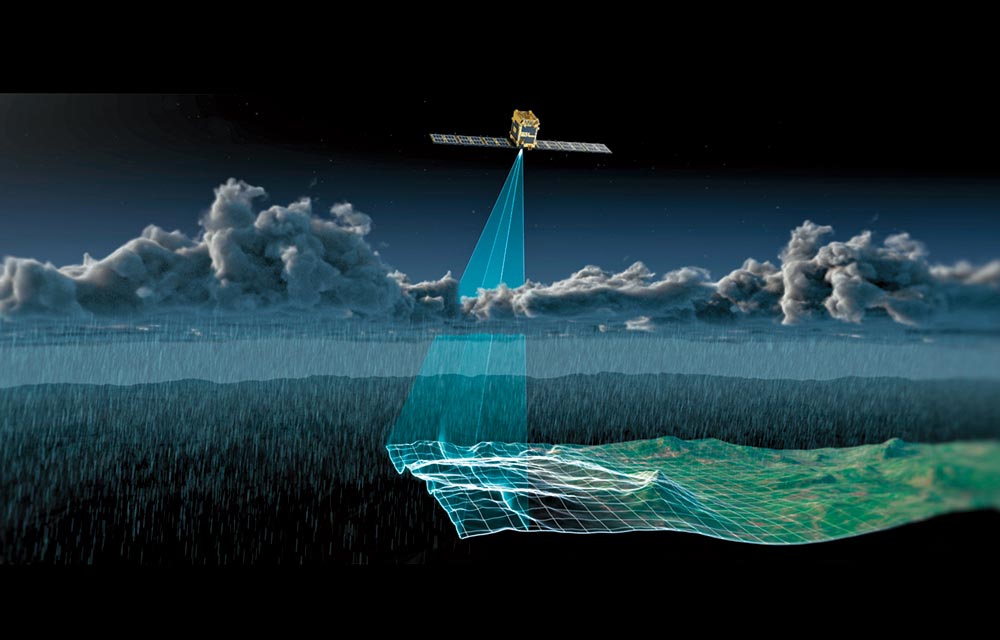
Computer graphic image of a small SAR satellite recording data. The satellite transmits microwaves and then receives the microwaves reflected back off the earth’s surface. Microwaves are able to penetrate cloud cover, enabling the recording of data in any weather conditions, day or night.
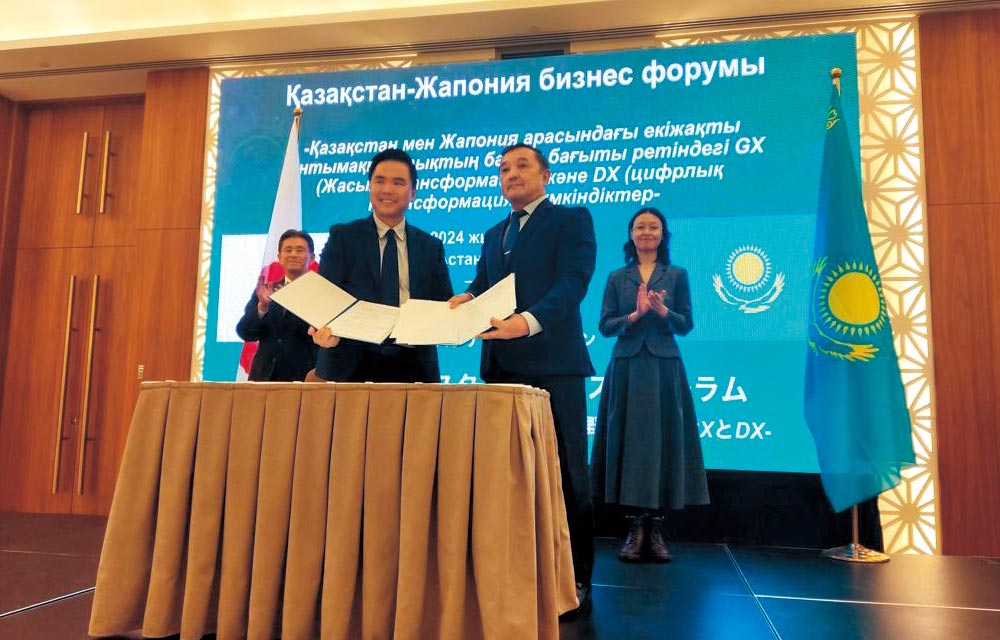
General Manager of Synspective Inc. (left) at the signing of a Memorandum of Understanding with Kazakhstan on the use of small SAR satellites to prevent disasters (Photos: Synspective Inc.)
Preparations for Operation Space Clean
It is estimated that over 100 million pieces of space junk are orbiting around Earth, including debris from defunct satellites and rockets that could cause extensive damage if they collide with satellites or space stations. Astroscale Inc. has taken on an extremely unusual mission, a rare global effort to remove debris hindering space exploration. Launched in 2024, the ADRAS-J satellite is now safely closing in on in-orbit debris moving at ultra-high speeds of 7–8 kilometers per second. Initially several thousand kilometers relative to each other, but they have succeeded in reducing that distance to 15 meters, among other things. Astroscale is moving ahead with the development of ADRAS-J2, a satellite capable of removing pieces of debris as large as 11 meters in length.

Computer graphic image of the ADRAS-J satellite approaching debris (right) for close-range observations
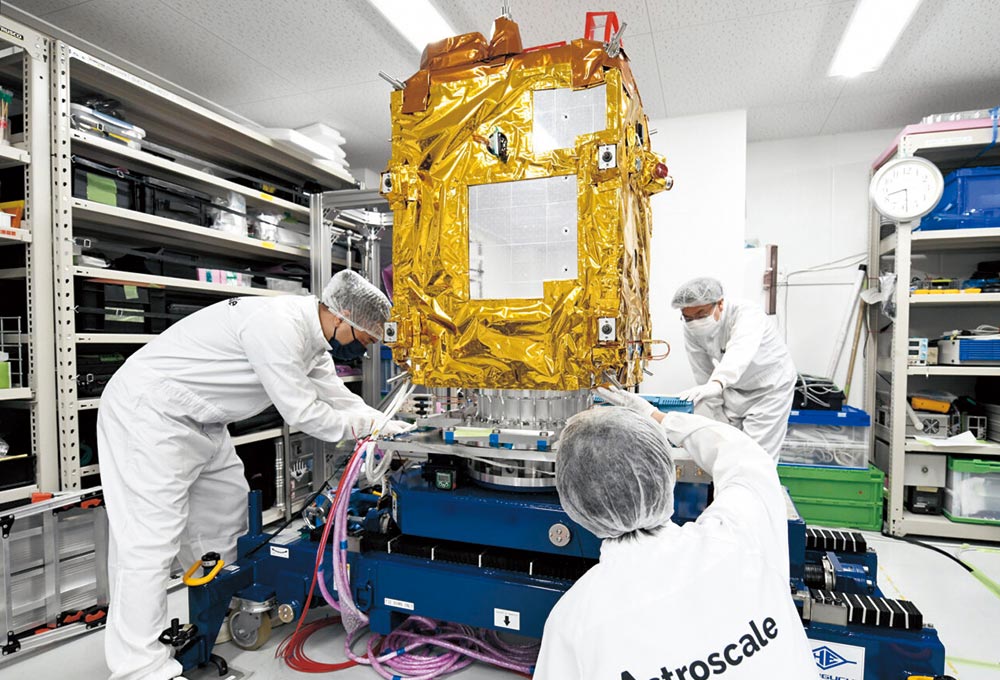
ADRAS-J at the time of development
Photos: Astroscale Inc.
Driving Asian Space Programs and Human Resource Development
Hokkaido University, located at the north land of Japan, is one of the few universities in the world where researchers from the engineering department, with its focus on developing rockets and other equipment, engage in friendly competition with researchers in the science develop optical instruments for onboard satellites, and science, agriculture, and fisheries departments, who analyze the data recorded by satellites and spacecraft. Part of Hokkaido University’s Institute for Integrated Innovations the Space Mission Center collaborates with private companies and neighboring universities on a variety of different space missions. The center has developed a number of new technologies, including engine systems for small satellites and 50kg-class nanosatellites.
The Space Mission Center has also worked since 2015 with the Philippines to develop the country’s first satellite, which led to establish the Philippine Space Agency (PhilSA). These efforts have expanded to other countries in Southeast Asia, and the “Asian Microsatellite Consortium” has been established with nine Asian countries participating, led by Hokkaido University and Tohoku University. An Asian space development network base is taking shape in Hokkaido.
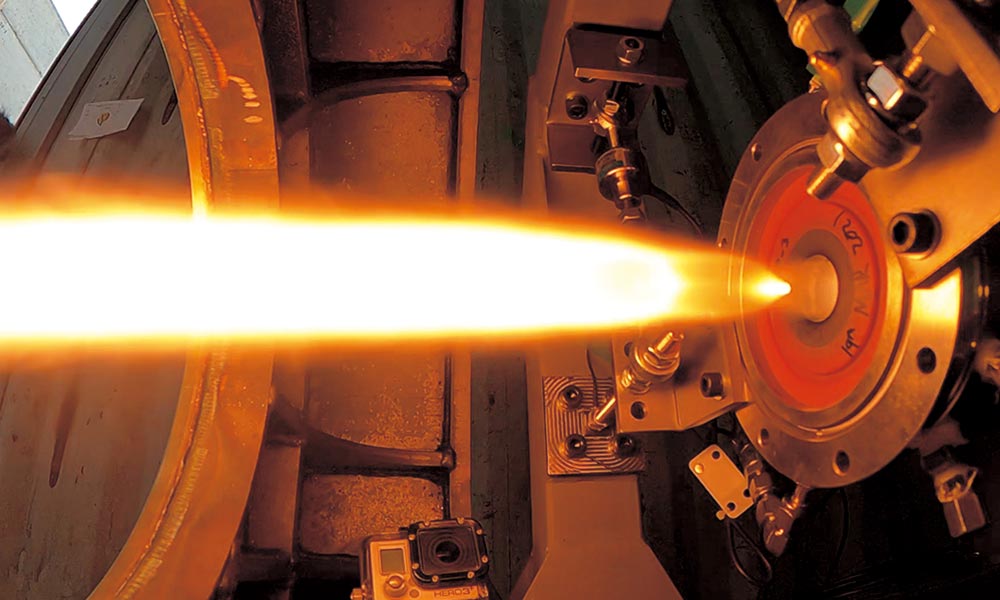
The hybrid kick motor for small satellites developed by the Laboratory of Space Utilization of Hokkaido University is useful in launches of multiple small satellites on a single rocket that are individually placed into their respective intended orbits. (Photo: Laboratory of Space Utilization of Hokkaido University)

A lab for young researchers from countries in Southeast Asia (Photo: Hokkaido University / Tohoku University)