

A New Chapter for Wood: How Japan is Redefining Sustainable Urban Design
Glass, steel, and concrete define most modern city skylines. Yet in Japan, a quieter revolution is underway: architects are turning back to wood, one of the world’s oldest building materials, to create cities of the future.
The wooden renaissance
Wood has always held a special place in Japan. From the soaring pagodas of Nara to the intricate joinery of Kyoto townhouses, traditional architecture relied on timber not only for its beauty but also for its resilience against earthquakes. Over time, however, the rise of modern construction pushed concrete and steel to the forefront.
The pagoda at Horyuji Temple in Nara is one of the oldest surviving wooden towers in the world.
The pagoda at Horyuji Temple in Nara is one of the oldest surviving wooden towers in the world.
Now, the benefits of utilizing wood are being reevaluated. This is not nostalgia but innovation: Japan is using timber to reduce carbon emissions, support sustainable forestry, and create urban spaces that feel warmer, more inviting, and more human. Thanks to engineered products like cross-laminated timber—strong, fire-resistant panels built from layers of wood—architects can design larger, taller, and safer buildings than before.
Tokyo’s timber towers
This new landmark will be Japan’s largest timber office tower when it is completed in 2028.
This new landmark will be Japan’s largest timber office tower when it is completed in 2028.
Nihonbashi, the commercial center of Tokyo, is preparing for a new landmark. This 17-story building, set to be Japan's largest timber office tower, is designed to bring the atmosphere of nature into the heart of Tokyo. Scheduled for completion in 2028, it will serve as a model for how workplaces can blend sustainability with comfort.
The wood-heavy interior softens the atmosphere of the workplace, creating a warmer environment.
The wood-heavy interior softens the atmosphere of the workplace, creating a warmer environment.
Domestic lumber is at the core of the design, making effective use of forest resources and supporting Japan’s forestry industry. Inside, wooden beams and generous open spaces echo the calm tranquility of a forest. The result is a workplace where an open layout and natural textures reduce stress and encourage productivity.
Wood is being used more and more in office buildings in central Tokyo. (Photo courtesy of Yamato Holdings Co., Ltd.)
Wood is being used more and more in office buildings in central Tokyo. (Photo courtesy of Yamato Holdings Co., Ltd.)
This embrace of timber is also evident in the logistic company`s project, which utilizes wood as the primary construction material in Tokyo’s central Ginza district. This pioneering initiative features a hybrid structure of steel and timber, showcasing a strong commitment to sustainable urban design.
Osaka’s Grand Ring: a sustainable second life
The Grand Ring was a major symbol of Expo 2025 Osaka, Japan. (Photo courtesy of Ibamoto – CC BY-SA 4.0, https://creativecommons.org/licenses/by-sa/4.0/)
The Grand Ring was a major symbol of Expo 2025 Osaka, Japan. (Photo courtesy of Ibamoto – CC BY-SA 4.0, https://creativecommons.org/licenses/by-sa/4.0/)
Recognized by Guinness World Records as the world’s largest wooden architectural structure, the Grand Ring was the defining landmark of the World Expo 2025 in Osaka, expressing the concept of “Unity in Diversity.”
Some of the wood from the Grand Ring is set to be reused at GREEN×EXPO 2027. (Photo courtesy of Hiromitsu Morimoto)
Some of the wood from the Grand Ring is set to be reused at GREEN×EXPO 2027. (Photo courtesy of Hiromitsu Morimoto)
It is constructed using a fusion of modern construction methods and traditional nuki joints—horizontal beams slotted through posts and secured without nails. Long used in Japanese architecture, these joints let wooden structures flex during earthquakes while reducing the need for metal fasteners.
Building on this commitment to sustainability and legacy, the city of Yokohama plans to reuse some of the dismantled some wood from the Grand Ring at the GREEN×EXPO 2027. This pioneering move not only continues the structure's lifecycle but also serves to connect the spirit and material history of the two major events, transforming an architectural centerpiece into a lasting environmental symbol.
Warmth and safety in wooden construction
Japan is developing advanced timber technologies to ensure wood performs reliably in urban settings. (Photo courtesy of CYPRESS・SUNADAYA CO.,LTD, Obayashi Corporation Photos: Sode Naomichi)
Japan is developing advanced timber technologies to ensure wood performs reliably in urban settings. (Photo courtesy of CYPRESS・SUNADAYA CO.,LTD, Obayashi Corporation Photos: Sode Naomichi)
Building with wood in modern cities means proving timber can be made as safe as concrete or steel. In Japan, architects and engineers make use of advanced timber technologies that ensure wood performs reliably in urban settings. These include cross-laminated timber and silicate-based coatings—a form of liquid glass applied to wood to shield structural elements from fire. Combined with Japan’s own traditions of wooden construction—developed over centuries to withstand seismic forces—these systems allow buildings to meet the same strict building codes as concrete or steel.
Wood is key to creating warm, welcoming spaces with an organic aesthetic. (Photo courtesy of Obayashi Corporation Photos: SS Co., Ltd. Sode Naomichi)
Wood is key to creating warm, welcoming spaces with an organic aesthetic. (Photo courtesy of Obayashi Corporation Photos: SS Co., Ltd. Sode Naomichi)
Comfort is as vital as safety in modern architecture, and wood offers qualities that other materials cannot. Its organic warmth and tactile character make spaces more welcoming, turning offices into healthier workplaces and public areas into locations where people want to gather. Timber bridges the gap between nature and architecture, creating spaces that feel alive.
A new chapter of urban wood architecture
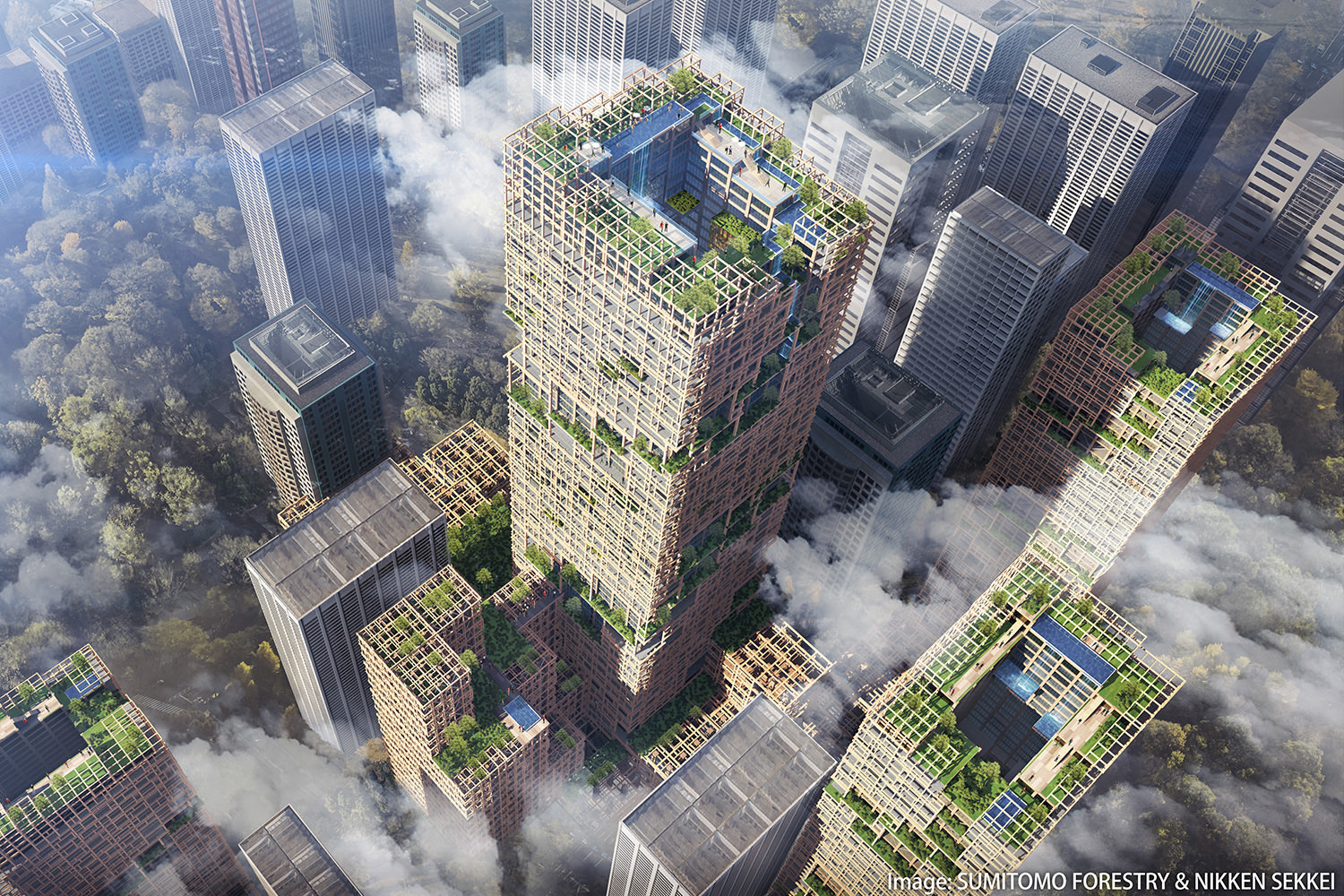
The W350 Project is set to be the world’s tallest wooden building.
The W350 Project is set to be the world’s tallest wooden building.
By embracing timber, Japan is reshaping the future of urban design. Looking ahead, proposals such as Tokyo’s W350 Project, scheduled to be completed by 2041, hint at the scale of this ambition. Planned as a 350-meter tower built primarily from timber, it will become the world’s tallest wooden skyscraper once complete, standing as a symbol of how far wooden architecture can reach. It reflects Japan’s determination to blend tradition with innovation and lead the way in sustainable urban design.