

A Stroke of Brilliance: Calligraphy Performances in Japan
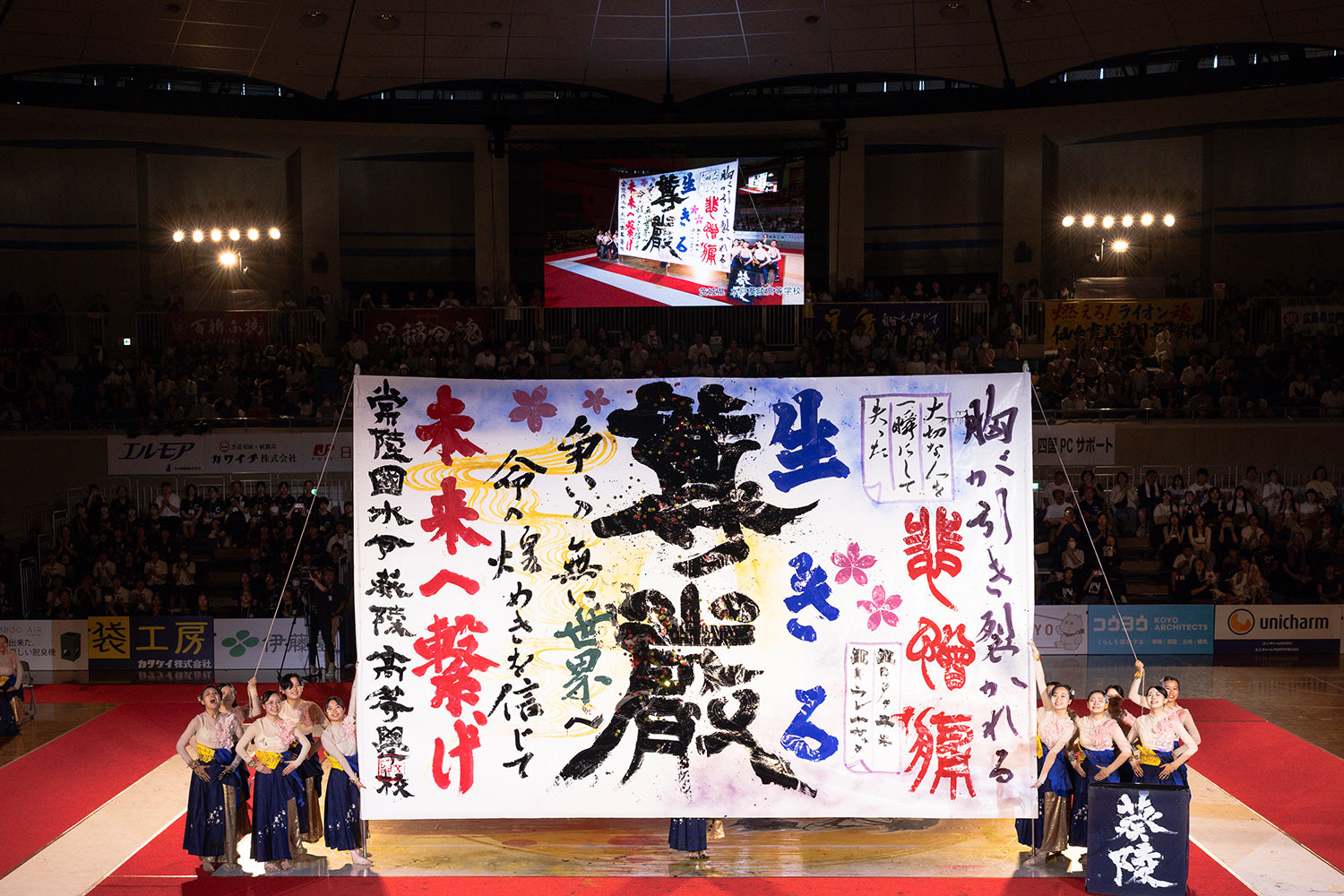
(Photo courtesy of The Shodo Performance Koshien Promotion Committee)
At a venue in Ehime, 12 high school students stand before a sheet of paper stretched across the floor. Music plays, and they move in coordinated waves, brushes in hand. They have less than 10 minutes to complete their work—writing lyrics or meaningful phrases in bold strokes while moving to the rhythm. Once time is up, the students lift the completed piece for the audience to see. This is shodo performance, where Japan's centuries-old art of calligraphy meets modern theatrics.
Roots of Japanese calligraphy
Brushes used in Japanese calligraphy come in a variety of shapes, sizes, and materials.
Brushes used in Japanese calligraphy come in a variety of shapes, sizes, and materials.
Shodo, or Japanese calligraphy, has been practiced for over fifteen centuries. During the Edo period (1603–1868), shodo became popular among the working class and evolved into an art form. Today, shodo remains an important part of Japanese life. It is part of the curriculum in schools around Japan, starting as early as the elementary level. Many Japanese adults enjoy calligraphy as a relaxing activity and hobby.
Japanese children have opportunities to enjoy calligraphy at school from a young age.
Japanese children have opportunities to enjoy calligraphy at school from a young age.
The way of writing
Japanese calligraphy is far more than the pursuit of aesthetic perfection. It is considered a do—a “way” of life—where the brush becomes an extension of the artist’s spirit. Traditionally, the creative process is intensely private; a silent confrontation with the self, where every stroke is final. In a contemporary context, shodo remains a meditative outlet to find calm within an increasingly overstimulating world.
The discipline has long held a public dimension. Since the Edo period, artists have brought the once-solitary practice out to be practiced before a crowd. This creates a fascinating relationship between the performer and the audience: the calligrapher must maintain their inner stillness even while performing, with the act transcending the boundaries of the paper. Through these public displays, the artist transforms a private meditation into a shared experience, drawing inspiration from the people.
Tournament culture
Two students add the final touches in a shodo performance, showcasing how the art is open to everyone. (Photo courtesy of The Shodo Performance Koshien Promotion Committee)
Two students add the final touches in a shodo performance, showcasing how the art is open to everyone. (Photo courtesy of The Shodo Performance Koshien Promotion Committee)
In 2001, students at a high school in Ehime combined choreographed calligraphy performances with popular music as part of local revitalization efforts. This initiative developed into the Shikokuchuo Shodo Performance Tournament, first held in 2008 with three participating schools. The event has since grown into a national competition, with more than 100 schools taking part each year. Teams of up to 12 students perform on 4-by-6-meter sheets of paper, choreographing their movements to music within a 6-minute time limit. The performances have gained widespread recognition and were even featured in a film.
Professional practitioners
Beyond competitions, professional calligraphers bring shodo into a wide range of live settings. Artists such as KUWANA Ryuuki, whose background includes dance, approach calligraphy as a full-body experience. Using oversized brushes and responding to music, she creates works that emphasize movement as much as form.
Calligraphy performances are sure to draw a crowd, as seen here with artist KUWANA Ryuuki. (Photo courtesy of Ryuki Kuwana, Japanese Calligrapher)
Calligraphy performances are sure to draw a crowd, as seen here with artist KUWANA Ryuuki. (Photo courtesy of Ryuki Kuwana, Japanese Calligrapher)
Other artists balance teaching with performance work, such as TANAKA Shorai, who opened a calligraphy studio in 2018, and SHIN-REI, who began practicing at age seven. Both emphasize that effective performance requires more than technical skill. Music selection, presentation, and audience connection all matter.
Artist SHIN-REI in the middle of a calligraphy performance at Sumadera Temple in Kobe, Hyogo Prefecture. (Photo courtesy of Calligrapher shin-rei)
Artist SHIN-REI in the middle of a calligraphy performance at Sumadera Temple in Kobe, Hyogo Prefecture. (Photo courtesy of Calligrapher shin-rei)
Contemporary calligraphers increasingly work across diverse contexts, from performances at venues like the Louvre Museum to commercial projects.
The power of words
Calligraphy performances reveal how written language can travel beyond the page to become a shared, emotional experience. Whether created by students on a competition floor or by professionals on international stages, each performance turns words into motion, sound, and collective memory. Presented in live settings, shodo retains its cultural core while offering a clear and immediate connection between writer and audience. This fusion of discipline and expression demonstrates that the power of words lies not only in what is written but in how it is written and experienced.