|
Top Picks ||
Arts & Entertainment ||
Business & Economy ||
Education & Society ||
OBUCHI NAMES CABINET: Government to Focus on Economic Issues July 31, 1998 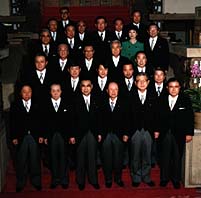 Keizo Obuchi (third from left, front row) and his cabinet; Masahiko Koumura, the new foreign minister, stands behind his right shoulder. On July 30 former Foreign Minister Keizo Obuchi named his choices for his new cabinet, after being elected Prime Minister in an extraordinary session of both houses of the National Diet. Obuchi, who was elected president of the Liberal Democratic Party on July 24, replaces Prime Minister Ryutaro Hashimoto, who resigned following the LDP's setback in the July 12 House of Councillors (Upper House) election. This LDP setback was reflected in the Diet's voting to install Obuchi as Prime Minister. He garnered a majority 268 votes in the 500-seat House of Representatives (Lower House), enough to gain him the nomination despite his loss in the Upper House to Naoto Kan, leader of the opposing Democratic Party of Japan. This marked the first time the Diet split in its vote for a Prime Minister since 1989. Obuchi immediately set about naming his cabinet, which he said would focus on reconstruction of the nation's limping economy. The key post of finance minister went to veteran politician and former Prime Minister Kiichi Miyazawa, whose economic expertise is highly valued by Obuchi. The new cabinet is also notable for its inclusion of a nonpolitician. Popular author and commentator Taichi Sakaiya, whose real name is Kotaro Ikeguchi, was tapped to head the Economic Planning Agency. A former bureaucrat with the Ministry of International Trade and Industry, Sakaiya left the government in 1978 to pursue a writing career. Named to the post of education minister was Akito Arima, who was elected to the Upper House for the first time in the election earlier this month. The former president of Tokyo University and chairman of the government's Central Council on Education is expected to take the initiative in educational reform. Also adding breadth to the cabinet is Seiko Noda, the posts and telecommunications minister. At 37, Noda is the youngest cabinet member in the postwar era, and is the only female to serve under Obuchi. She has experience as a parliamentary vice minister in the ministry she now heads. The full lineup of the Obuchi cabinet is as follows (the names of the ministers are followed by their age, house membership, and major posts held to date): Prime Minister Justice Minister Foreign
Minister Finance Minister Education Minister Health and Welfare
Minister Agriculture, Forestry, and
Fisheries Minister International Trade and
Industry Minister Transport Minister Posts and Telecommunications
Minister Labor Minister Construction Minister Home Affairs Minister Chief Cabinet Secretary
(State Minister) Director General,
Management and Coordination Agency (State Minister) Director
General, Hokkaido Development Agency and
Okinawa Development Agency
(State Minister) Director General, Defense Agency
(State Minister) Director General, Economic
Planning Agency (State Minister) Director General, Science and
Technology Agency (State Minister) Director General,
Environment Agency (State Minister) Director General, National
Land Agency (State Minister)
 Edited
by Japan Echo Inc. based on domestic Japanese news sources.
Articles presented here are offered
for reference purposes and
do not necessarily represent the
policy or views of the Japanese
Government. Edited
by Japan Echo Inc. based on domestic Japanese news sources.
Articles presented here are offered
for reference purposes and
do not necessarily represent the
policy or views of the Japanese
Government.
|
