
|
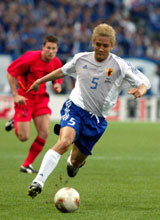 Japanese midfielder Jun'ichi Inamoto in action against Belgium. (Jiji) |
THANKS FOR THE WORLD CUP MEMORIES:
Japan's Success Thrilled the Public
July 8, 2002
The 2002 FIFA World Cup, co-hosted by Japan and South
Korea, captivated the Japanese public throughout June. In its second appearance
at the World Cup finals, the Japanese team chalked up its historic first
ever World Cup points and qualified for the knockout stage as the winner
of Group H. After Japan lost to Turkey in the round of 16 on June 18,
the excitement died down just a little. Major newspapers took the chance
to comment on the World Cup in their editorials.
The Football Feel-Good Factor
Japan ended its first World Cup appearance four years ago in France without
a single point, but this time the team claimed seven points by winning
two games and drawing one. Although it failed to progress past the first
of the knockout rounds, many Japanese were delighted with the team's performance.
Newspapers echoed this sentiment with headlines like "Well Done!
A Round of Applause from Everyone" (Mainichi
Shimbun) and "The Japanese Team Gave Us Something to Cheer"
(Yomiuri Shimbun).
Amid a long period of economic troubles, there have been few pieces of
good news for the Japanese public to smile about. In this context the
performance of the Japanese team was warmly welcomed, and as Japan accumulated
points, cries of "Nippon! Nippon!" (Japan! Japan!) could be
heard in the more lively parts of town. The Yomiuri
Shimbun commented: "Many people feel there is little light
at the end of the tunnel, but the Japanese team really showed us that
if we try, we can succeed - not just in soccer but in life." The
Asahi Shimbun, meanwhile, said: "It is
no exaggeration to say that the confident play of these young men with
their hair dyed red, silver, or gold showed us that the future of our
country is full of life and diversity."
Japan's French manager, Philippe Troussier, was the subject of much editorial
comment. Troussier was invited to take over the team after the 1998 World
Cup in France. He once said that the problem with managing Japan was "more
than technique or tactics, the tendency for Japanese people to stick with
what they know and the 'cultural wall' around Japanese society."
He sometimes came into conflict with the powers that be in Japanese soccer
over how the team should be led. After leading Japan to the last 16 of
the World Cup, however, Troussier was showered with praise. The Nihon
Keizai Shimbun said: "This success deserves special mention.
Thanks to Troussier, Japan's key players have learned a lot from foreign
teams and have become more determined." The Mainichi
Shimbun observed: "At times Troussier got so emotional that
he seemed eccentric. He broke down Japan's tradition of not letting people
stand out from the crowd and of hierarchy based on seniority and introduced
a new atmosphere. Opinion is likely to be divided on Troussier, but a
Japanese manager would surely have had difficulty achieving the same success."
Some quarters of the media compared Troussier to
Carlos Ghosn, the president of Nissan Motor Co. who came from Renault
and has turned Nissan's fortunes around in a short space of time.
Cup Boosts Japan-South
Korea Relations
During the selection process for the venue of the 2002 FIFA World Cup,
Japan and South Korea fought hard for the right to act as host country,
but in the end FIFA decided that the two countries should host the event
jointly. The Tokyo Shimbun said of the first
ever co-hosting of the World Cup: "The words 'Let's meet in the final'
became common currency among fans from the two nations, who shared the
same feelings about the event. Leaving past troubles behind, people in
both countries - especially the younger generation - have been writing
a new chapter of history in the form of their shared memories of this
great event." The Mainichi Shimbun expressed
support for the South Korean team: "The World Cup is over for the
Japanese team, but South Korea is still in the hunt. For the sake of Asia,
let's hope they continue to win." Until now many observers have described
Japan and South Korea as two countries that are "so near, yet so
far apart," but co-hosting the World Cup has undoubtedly enabled
them to take a step toward closer relations.
|
Copyright (c) 2002 Japan
Information Network. Edited by Japan Echo Inc. based on domestic Japanese
news sources. Articles presented here are offered for reference purposes
and do not necessarily represent the policy or views of the Japanese
Government. |
|
|


