
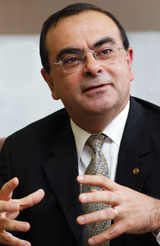
Trends in Japan is featuring interviews with notable foreign residents of Japan. Our third interviewee is possibly Japan's most famous foreign resident, Nissan President Carlos Ghosn.
|
 |
CARLOS GHOSN:
Standing at the Global Crossing
April 5, 2002
"Very vague" is how Carlos Ghosn describes his impression of Japan before being sent to the country in June 1999 by Renault to revive its alliance partner Nissan Motor. "I did not try to learn too much about Japan before coming, because I didn't want to have too many preconceived ideas. I wanted to discover Japan by being in Japan with Japanese people," Ghosn says, and the discoveries he has made so far have been mostly positive.
Learning About Japan
Punctuality - both in and outside the workplace - was the first thing that impressed Ghosn about the Japanese. "When dinner is at seven o' clock, everybody arrives at seven; when it finishes at nine o' clock, everyone leaves at nine." Dedication to work was another, which he says is evident not only in industry but in the general quality of service in Japan. "When the processes are clear and well organized, people are extremely dedicated to what they do."
Meanwhile, he describes the politeness and discretion demonstrated by the Japanese people as "never too much or indifferent, but just what it takes to be nice and friendly." Safety is another striking aspect of life in Japan, says Ghosn, who has lived in "not very safe" places, such as Rio de Janeiro. "I let my children take the train, even late at night, and nothing ever happens."
His family has also developed a liking for such things as the variety of Japanese noodles and soups, and the Ghosns now have their meals earlier, as well. "There are lots of habits that we've adopted in the family," Ghosn says. "We walk without our shoes in the house, for example. And we do the same in France now, too."
Changing the Business Culture
Unfortunately, Ghosn's discoveries weren't all positive. The "lack of a sense of urgency" was something he noticed early on. Instead of solving the problem, the Japanese were "just coping with it," he says. "Another thing, too, which was surprising, is how heavy the power of hierarchy is. I have been working in different countries where obviously the boss is the boss, but you can still tell him what you think. Here, it was important from the beginning to tell people, 'Look, I need to know what you think. It's very important for the company.' And this has taken some time. Obviously the people are a little bit reticent at the beginning. They need to know if you really mean it or not."
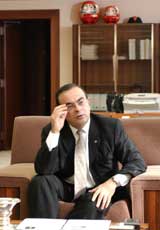
At Nissan, Ghosn encountered resistance to his "cross functional teams," which bring together people from different divisions as a task force. He says, "Japanese are very territorial, you know. It's called sectionalism in Japan. Japanese like to have their section, their territory, their own team, and they would defend their territory very well. This was a little bit of a surprise."
|
 |
Ghosn has a simple solution for overcoming differences: Make it worth everyone's while to do so, he says, and demonstrate the measurable common benefits to be gained. Born in Brazil, French by nationality, raised in Lebanon, and having worked in France, Brazil, the United States, and now Japan, Ghosn fully appreciates the value of embracing differences and learning from them. "When you're working with people who are different from you, you're going to question yourself. Am I doing the right things? Can I do things differently? Why is he doing this? Maybe there is something I can learn from it. So difference creates wealth and enrichment."
Renault and Nissan are currently involved in this process of mutual learning, Ghosn says. Extensive benchmarking in their respective plants revealed higher productivity at Nissan and lower costs at Renault. "So Renault is learning from Nissan everything which is related to productivity, and Nissan is learning from Renault everything which is related to overall cost."
Looking to the Future
This mutual learning is part of a larger process in the world towards the emergence of truly "global" business standards, he says. "It's true that the American economy, or the American model, has a lot of influence. But saying 'global equals American' - I don't think it's factual; I don't think it's true. In the global model you have a lot of influence today coming from Japan, coming from European countries, coming even from emerging countries like China and South American nations, and so on. It's normal, because when you think about the global economy, you have a lot of people coming from different practices."
"Global is global," Ghosn says. "In my opinion, this is going to be the story of the twenty-first century. This is what's going to happen in the twenty-first century - you're going to see the emergence of more 'global' standards, some kind of global references; you're going to see more and more of it. But 'globality' doesn't mean 'uniformity.' It doesn't mean that. You'll still have different cultures, you'll still have different tastes, and you'll still have some adaptations to make to different countries, but you'll have some basic things that will be common globally, especially in the economic area."
|
Trends in Japan Home |
This is the third time Ghosn has found himself working in the host country in a World Cup year: the United States in 1994, France in 1998, and now Japan, which will co-host this year's World Cup with South Korea. With close ties to both Brazil and France and now president of a Japanese company, Ghosn tries to sort out his preferences in this year's World Cup. "I have at least three teams I will be following very carefully. Now, who am I going to support?" He grins. "The one who's going to produce the best soccer, you know."
 Carlos Ghosn
Born in 1954. Graduated from France's �cole polytechnique, where he majored in engineering. Joined Michelin in 1978 and served as chairman and chief executive officer of Michelin North America. Joined Renault in 1996 and served as executive vice president; has been chief operating officer of Nissan Motor Co. since June 1999 and company president since June 2000.
|
Copyright (c) 2002 Japan Information Network. Edited by Japan Echo Inc. based on domestic Japanese news sources. Articles presented here are offered for reference purposes and do not necessarily represent the policy or views of the Japanese Government. |


