
|
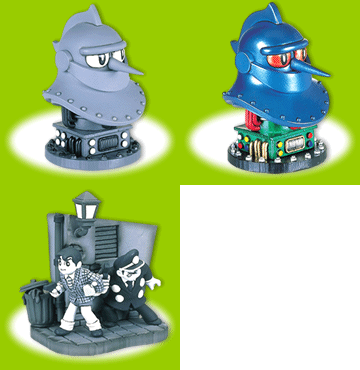 Among the prizes found in Glico caramel boxes are figurines based on the comic book and TV series Tetsujin 28-go (Gigantor). (©Tetsujin 28, ©KAIYODO) |
BACK TO THE PAST:
Japanese Nostalgic for All Things Showa
January 22, 2003
The Showa era in Japan began in 1926 and lasted until
early 1989. During the long era Japan experienced World War II from
1941 to 1945, the subsequent recovery, and the remarkable economic growth
of the postwar period. A Showa nostalgia boom is clearly underway in Japan,
as cover songs of hits from the 1950s and 1960s, food products of that
era, and even older buildings are all popular at the moment.
Revisiting Youth
One sign of the Showa nostalgia is the revival of a caramel candy produced
by Ezaki Glico
Co. (site is Japanese only) that comes with a prize. Called Timeslip
Glico, the first production run went on sale in November 2001. It was
an instant hit, selling 13 million boxes and racking up sales of about
¥2.5 billion ($21 million at ¥120 to the dollar). Building on
this success, Glico rolled out a second series with different prizes in
July 2002.
The original Glico caramels were first marketed in 1922. They quickly
gained fame as a "nutritious" snack thanks to the catchphrase
"the 300-meter candy," which referred to the claim that each
piece of candy contained the calories needed to run 300 meters. In 1927
the company began putting a toy prize in each box. Production of the candy
ceased during World War II, but boxes of the candy containing prizes went
back on the market in 1950. In an age of shortages, this candy achieved
immense popularity. Timeslip Glico is a reproduction of this classic treat.
|
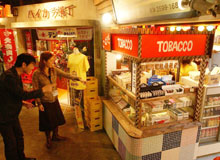 Visit the fourth floor of Decks Tokyo Beach for a taste of downtown Tokyo in the 1950s and 1960s. (Jiji) |
In a modern Japan where every snack imaginable is available in abundance,
what is it that has sparked interest in a traditional candy? The answer
lies in the prizes, which are miniature toys of things that were popular
at the time. They come in a great variety and include robots from comic
books that were popular with kids and models of best-selling cars and
electrical appliances. Seeing these things once again takes many adults
right back to their youth.
Cover Songs
Candy is not the only Showa artifact experiencing a revival. A hit song
from 34 years ago, "Amairo no kami no otome" (The Girl
with the Light Brown Hair), has been covered and is back on the charts
once more. Written and first performed by the Village Singers, a group
of college students who got together to form a band in 1966, the original
version had an easygoing feel. At the time Japan was booming, posting
double-digit economic growth, and the younger generation was riding a
new cultural wave. Under influence from the Beatles and other such groups,
a new genre of music was born in Japan, known as "group sound."
Now that Japan has undergone great changes, an uptempo version of "Amairo"
has been released. The singer this time, 21-year-old Hitomi Shimatani,
had not even been born when the song originally debuted. Other hit pop
songs from the 1960s have been arranged in the current J-pop style and
rereleased as well. A music critic who has analyzed this phenomenon comments,
"Songs with a retro feel strike a chord with the current generation
of young people, who are uneasy about the future."
Step Back in Time
In Ome City, Tokyo, the Retro
Museum of Packaging from the Showa Era (site is Japanese only), constructed in 1999, has displays
of a wide variety of products from the 1950s and 1960s, including canned
food, candy, stationery, and movie posters. The area around Sumie-cho
shopping district south of Ome Station, where the museum is located, escaped
bombing during World War II, and it has also escaped redevelopment over
the years since then. Many of the old buildings remain virtually intact.
The local association of Sumie-cho retail establishments decided to use
the area's age as a strength rather than a weakness, promoting its Showa
heritage and creating the Retro Museum as a symbol for it. The museum
and the shopping street have become quite popular with Showa aficionados.
The head of the association offers a theory to explain the interest in
this period: "People certainly are a lot freer these days, but the
social norms and the kindness that existed back then have disappeared.
Maybe that's why more and more people are remembering the Showa era fondly."
At Decks Tokyo Beach, a shopping complex in Tokyo's trendy Odaiba area,
part of the fourth floor is a re-creation of Tokyo's Shitamachi district
(the old downtown area) from the 1950s and 1960s, down to the last detail.
Products that were popular then but are hard to come by now are on sale.
Visitors can also purchase pudding, candy, or lunches that bring back
memories of that time. For older customers, a visit may seem like a trip
back to their youth, but younger patrons also come, as they find the retro
feel to be new and different. Even people who were not yet born at the
time are enjoying the Showa nostalgia boom.
|
Copyright (c) 2003 Japan
Information Network. Edited by Japan Echo Inc. based on domestic Japanese
news sources. Articles presented here are offered for reference purposes
and do not necessarily represent the policy or views of the Japanese
Government. |
|
|


