
|
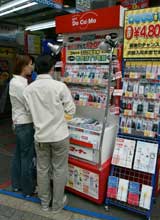 Shoppers in Tokyo browse a selection of mobile phones. (PANA) |
AN EMERGING "THUMB CULTURE":
Multimedia Mobile Phones Usher in New Lifestyles
January 10, 2003
Mobile phones have transformed how the Japanese spend
time on the train. In the past, an overwhelming number of passengers could
be seen reading books, newspapers, and other printed material. For many
visitors from overseas, this scene was symbolic of the diligent Japanese.
Now, however, cell phones have become another major provider of entertainment
on the train. These phones, while being so compact as to fit comfortably
inside one's pocket, are extremely versatile multimedia tools that allow
users to do everything from sending e-mail to playing online games, and
even listening to music.
Three examples are offered to illustrate how people of various ages are
integrating cell phones into their lives, each in his or her own way.

Yuka Ito, age 17 |

Koji Takahashi, age
29 |

Susumu Sasaki, age
75 |
Thumb Typing at Lightning
Speed
The spread of mobile phones has spawned a number of related events, including
a contest of cell-phone typing speed. One such competition in Tokyo attracted
nearly 300 contestants, who vied to be the first to finish typing a tongue
twister 12 characters long and submitting the results to a designated
e-mail address. The winner's e-mail was received in just 8 seconds. Taking
transmission time into account, this is equivalent to typing 100 characters
per minute - roughly the speed required to pass the top-level Japanese-language
word processing exam on a regular keyboard using 10 fingers, rather than
just 2 thumbs. According to one estimate, there are at least 1.5 million
people in Japan who can type on their cell phones at speeds like this.
The manual dexterity of the Japanese, made famous in the past by their
mastery of the abacus, is once again being brought into full play with
the spread of cell-phone e-mail.
Part and Parcel of Young People's Lives
There are nearly 80 million mobile phones in use in Japan, more, in fact, than the
number of wired phones. Japan's population is roughly 127 million, meaning
that three out of five people own a mobile phone. Of these phones, close
to 75% have access to the Internet. In Japan, personal computers cannot
be called the standard medium for surfing the Net; the cell phone is steadily
becoming the most familiar information equipment.
What is the top possession that young Japanese women cannot stand forgetting
at home? According to a recent survey, it is neither their wallets nor
their handkerchiefs, but their cell phones. When these women forget their
phones at home, they are restless and feel insecure all day. For today's
young people, the cell phone is an alter ego with which they can connect
with friends and society 24 hours a day. And it is precisely because
the phone is virtually a part of themselves that they spend so much time
and money customizing it, by downloading their favorite songs for
ring tones, by attaching straps, stickers, and other ornaments, and in
other novel ways.
Total Communication and
Entertainment Tool
No machine has ever won over so many users or been
so universally embraced by all age groups as the mobile phone. One reason
for its acceptance has been the rapid pace of technological development.
The latest phones being marketed by Japan's mobile phone carriers have
a video camera function. J-Phone was the first to offer this service,
which enables users to capture up to five seconds of moving images with
a built-in camera, and by November 2002 sales of movie-capable phones
had topped the 1 million mark. Phones with built-in cameras (including
those for still images) accounted for about 30% of the approximately 20
million units sold between April and September 2002, according to the
Multimedia Research Institute. The share is expected to rise to over 70%
in the half year starting in October 2002.
Other state-of-the-art functions include a display that will turn into a mirror;
an infrared-transmission feature, eliminating the need to send images
over the phone network; and the world's first liquid-crystal display capable
of showing 3D images. Cell-phone services are expected to expand even
further, making these devices less of a phone and more of a total multimedia
communication and entertainment tool.
|
Copyright (c) 2003 Japan
Information Network. Edited by Japan Echo Inc. based on domestic Japanese
news sources. Articles presented here are offered for reference purposes
and do not necessarily represent the policy or views of the Japanese
Government. |
|
|


