
|
 |
Trends in Japan is featuring notable
personalities in Japan. The subject of our current article is softball
player Reika Utsugi, a Chinese-born naturalized Japanese citizen who helped
lead the Japanese national softball team to the silver medal in the 2000
Sydney Olympics.
REIKA UTSUGI:
Keeping Her Eye on the Ball
December 16, 2002
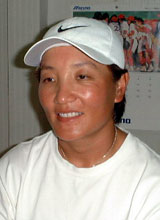
Reika Utsugi, a major star in the world of Japanese
women's softball, was actually born in China. A long-time admirer of Taeko
Utsugi, a former player who is now the manager of the Japanese national
team, she came to Japan in 1988 and since 1989 has been a member of the
Hitachi Takasaki Women's Softball Team, also managed by Taeko Utsugi.
Reika became a naturalized Japanese citizen in 1995 and represented her
new country in the 2000 Sydney Olympics.
Overcoming Obstacles
When Reika decided she wanted to come to Japan, however, she had to overcome
the resistance of her father, a former soldier, who was dead set against
the idea. She explains, "He asked me why I wanted to go to Japan
of all places. But I knew that as long as I could play for Taeko Utsugi,
I could enjoy softball there. I realized it was a bit of a risk, but I
was ready to take the chance to make my dreams come true."
Reika first met Taeko Utsugi, who at the time was a player on the Japanese
national softball team, while playing for the Chinese junior women's national
team at the age of 15. During a game between the Japanese and Chinese
national teams, Reika was taken with Taeko's strong play as she watched
from the stands. The following year at the World Junior Women's Softball
Championships held in Canada, Taeko served as a coach for the Japanese
junior women's national team, and Reika stopped by her hotel room every
day for advice. Taeko
smiles as she recalls the episode, saying, "She drew a batter's
box on a pad of paper and asked me how she should stand. She constantly
asked me about hitting. She was the only athlete who did that." After
the tournament came to an end, the two stayed in touch via letters
and phone calls.
|
 Reika, left, with national team manager Taeko. |
Reika says that being unable to communicate quickly with the other fielders
was one of the difficulties she experienced in softball after first coming
to Japan: "There were some games we lost because of that.
I couldn't forgive myself for having made my team lose because of my own mistakes."
Learning the True Nature of Japanese
After three months in Japan, Reika broke out in hives as a result of stress.
A little unsure of what to do, Reika went to her company's clinic, where
she was told that the doctor would not prescribe medicine because she
did not have health insurance. Commenting on the rigid stance taken by
the doctor, Reika says, "I thought the Japanese were so inhospitable.
In China, no matter how poor a person may be, the doctor will provide
medicine if the patient is in need." Because she could not receive
any medicine, the hives spread to her whole body, and she was unable
to do anything for a week. Reika's manager, teammates, and co-workers
offered words of comfort, however, and moved by their concern and their
efforts to help her, she came to think, "Japanese people are truly
kind."
There were other cultural differences as well. She explains, "While the
Japanese are kind, they don't often speak up for themselves and are sometimes
vague." Reika was amazed at this and says that in China she was taught
from a young age that "If you don't make things clear, you are the
one who suffers, and it creates a nuisance for others as well." According
to Reika, this mentality also applies to sports: "Even if Japanese
are good at defense, their offense is weak."
Coming Up Big at the Olympics
Softball became an official event at the 1996 Atlanta Olympics. This was
when Reika decided she wanted to become a naturalized Japanese citizen
so that she could honor her manager and pursue her dream of playing on
the world's biggest stage. This time her father in China, who had originally
opposed her going to Japan, gave his approval, saying, "You will
always be my daughter." When she took her manager's family name and
became Reika Utsugi, "Now I've really done it [become a Japanese
citizen]," she thought. "Though it was just for a moment, I
wondered if I had done the right thing."
Reika was then able to join the Japanese national
team, but she could not take part in the Olympics. According to the
Olympic Charter, an athlete who has changed his or her nationality less
than three years ago requires the permission of his or her former country
in order to participate. China did not give its approval. Shortly afterward,
Reika had to undergo surgery on her right shoulder followed by a difficult
process of rehabilitation. She did not give up, though, and her long-cherished
dream of playing in the Olympics finally came true in Sydney in 2000,
where she hit three home runs en route to helping the Japanese team to
the silver medal.
Utsugi has had to overcome numerous challenges since
coming to Japan from China, but what got her through it all was her devotion
to softball. "If there is something you want to do, you can absolutely
accomplish it," she says. "The road there will not be easy, but
that's to be expected."
Her interests are not limited to sports. As part of her effort to learn
more about Japanese society, Utsugi began playing the stock market seven
years ago. Even when her team is on the road, she checks the financial
newspapers. As busy as she is, Utsugi still has no plans to retire. She
says, "I'll retire when I start losing to younger players. I'm playing
well this season, and that's all that matters."
 Reika Utsugi
Born in Beijing, China, in 1963 as Ren Yanli.
Played for the Chinese junior women's national team and national team.
Came to Japan in 1988 and joined the Hitachi Takasaki Women's Softball
Team in 1989. Won the triple crown for batting average, home runs, and
RBIs in the Japan Softball League in 1994. Became a naturalized Japanese
citizen in 1995, adopting the name Reika Utsugi. Hit three home runs in
the 2000 Sydney Olympics to help the Japanese national team to the silver
medal. Plays third base. Bats left, throws right, and enjoys playing the
stock market.
|
Copyright (c) 2002 Japan
Information Network. Edited by Japan Echo Inc. based on domestic Japanese
news sources. Articles presented here are offered for reference purposes
and do not necessarily represent the policy or views of the Japanese
Government. |
|
|


