
|
 |
LICENSED TO ENTERTAIN:
New Scheme Gives Tokyo Street Performers Green Light
October 25, 2002
With just a license, musicians, mimes, and other
artists can now perform in specially designated public locations without
first receiving permission from the police and local government. This
new license system, which is a godsend for street performers, was put
into effect in Tokyo in September 2002. The official name of the system
is "Heaven
Artist." Previously, it had been extremely difficult for street
performers to receive permission due to concerns that they might block
traffic or disturb people. The new system, which is modeled after one
in New York, took its name from the fact that most of the publicly recognized
places for performances will be in the high-pedestrian-traffic areas of
Ginza and Shinjuku, locations ideal for street performers.
Intense Screening
In response to the new system, some 647 groups, most of them from the
Tokyo area, applied for licenses. A total of 247 groups passed the first
stage of the examination and were divided into the categories of performance
art and music. They then took part in public auditions
that began on July 30. Participants ranged in age from 16 to 79 and included
both men and women. There were also 18 groups made up of foreigners. A
total of 115 groups in the "performance" category and 25 in
the "music" category received certification, and these
included a total of 12 non-Japanese groups. A wide variety of performance artists,
such as mimes, jugglers, dancers, and magicians, received licenses.
|
 |
A Continuing Tradition
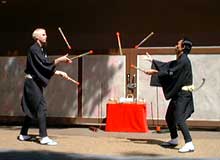
On the afternoon of September 20 at Tokyo's Inokashira Park, the Kosen
Kagami Troupe performed Edo daikagura, a traditional
type of juggling and lion dance. Daikagura
traces its roots to the Heian period (794-1185), but it first achieved
wide popularity in the Edo period (1600-1868). The dance was once a celebration
of Shinto gods and had religious overtones, but nowadays it serves mainly
as entertainment.
Daikagura involves a number of different acrobatic
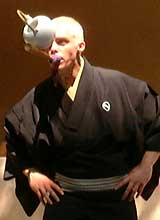
performances. There is the gokai jawan (five-story
bowl), in which the performer balances a wooden drumstick called a daijawan
on his chin and then places boards, bowls, and an object called a keshofusa
on top, one after another, while continuing to keep everything balanced.
Another performance is the wa no kumidori
(ring toss), in which two performers begin by tossing three rings between
them. They increase the number of rings to five and then six but never
have more than one in their hands at a time; the rest are flying through
the air. The troupe has 16 members and is led by Kosen
Kagami, the thirteenth grand master of daikagura
in his family.
Frenchman Joins Troupe
Performing that afternoon at the park were Senwaka Kagami and Sen'emon
Kagami. Senwaka Kagami joined the troupe in 1998 and has demonstrated
daikagura in the United States. Sen'emon Kagami
is the stage name given to Frenchman Pierre-Yues Cornec. Cornec is currently
23 years old and has been in Japan for three years. In France he was active
as a circus performer; he came to Japan after becoming acquainted with
a Japanese in his circus company. After coming across Edo
daikagura on the Internet, he became an apprentice and is now a
seasoned performer. He spends each day practicing the techniques of Edo
daikagura and studying Japanese.
At the park that afternoon, the two performers demonstrated a wide range
of techniques, from the basic kasamawashi
(spinning umbrella) to more complex tricks involving the bachi
and the mari (cloth ball). Whenever they pulled
off a trick, the crowd gathered to watch oohed, aahed, and applauded.
Senwaka Kagami says, "Street performers are treated completely differently
overseas than they are in Japan. Over there they are viewed as artists.
I hope the new Heaven Artist system will lead to an improved image for
street performers in Japan." At the same time, others have expressed
misgivings that the new system may make it difficult for street performers
to enjoy the freedom they once had to perform at a time and location of
their choice, flexibility that may allow them to draw a greater audience.
Cornec says, "It feels stifling to have to perform at a predetermined
time and place regardless of whether there is an audience present or not."
The new Heaven Artist system has just begun, and its goal is
to preserve street performing and bring it closer to the people. Hopes
are growing that this system will provide an opportunity for the revitalization of street performance.
|
Copyright (c) 2002 Japan
Information Network. Edited by Japan Echo Inc. based on domestic Japanese
news sources. Articles presented here are offered for reference purposes
and do not necessarily represent the policy or views of the Japanese
Government. |
|
|


