
|
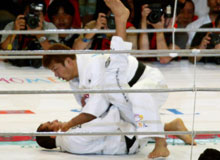 Yoshida and Gracie grapple for supremacy. (Jiji) |
NO HOLDS BARRED:
Japanese Gold-Medalist Judoka Enters World of Mixed Martial Arts
October 17, 2002
A style of fighting known as mixed martial arts is
currently enjoying a boom in Japan. On August 28, 2002, at the National Stadium
in Tokyo, Hidehiko Yoshida
(site is Japanese only), who won a gold medal in judo's
78-kilogram class in the 1992 Barcelona Olympics, made his professional
debut in the sport. He took on the legendary Royce Gracie of Brazil in
an event called "Dynamite," a collaborative event put together
by Pride (a no-holds-barred type of fighting) and K-1 (a combination of
karate, kickboxing, and kung fu). Before a record crowd of 90,000 and
many more watching at home on pay-per-view, Yoshida defeated Gracie by
technical knockout seven minutes into the bout. Although mixed martial
arts is not yet recognized as an official sport, this event was taken up by
much of the domestic media, even garnering some front-page stories in
major newspapers.
Judo Versus Jujitsu
Before ending his career as an amateur this April, Yoshida took part in
three consecutive Olympic Games beginning in 1992. Following his retirement
he opened a gym in Tokyo that teaches judo, but he had always been interested
in mixed martial arts. Yoshida's opponent for Dynamite was Royce Gracie,
a legendary jujitsu
fighter. Jujitsu is a form of judo that was brought to Brazil by Japanese
immigrants in the Meiji era (1868-1912). It was actually developed there
by the Gracie family, and it contains some techniques that are forbidden
in judo for being too dangerous. Hoyce Gracie's distinguished jujitsu
lineage and Yoshida's Olympic gold medal in judo led to their fight being
billed as a contest between judo and jujitsu. The battle between two masters
of different fighting styles attracted a great deal of attention in Japan,
and the National Stadium was used for this mega-event. A total of 90,000 fans
turned up, the largest crowd ever to attend a sporting event
in Japan. Yoshida went on to win his debut fight, and he is looking forward
to the next one, saying, "I'm happy for judo that I won. I want to
continue using judo techniques in my fights."
Hard-Fought Bouts
During the 1950s, Japan was caught up in a pro-wrestling craze. The biggest
star of that era, Rikidozan, captured the imagination of many Japanese with his
bouts against foreign wrestlers. It is even said that his matches were the biggest factor in the spread of television in Japan. Afterwards,
however, doubts began to arise about the competitiveness of pro wrestling,
and the sport came to be watched only as a entertainment.
Japan is a country that boasts a rich history of martial
arts, having been the birthplace of judo, karate, and sumo. This tradition
is proving to be fertile ground for new styles of fighting,
such as K-1 and the anything-goes style of Pride. These hybrid forms of
mixed martial arts are growing in popularity, with many fans
drawn to the clashes of different fighting styles that take place. Fans are usually treated to hard-fought matches.
Yoshida is not the first Japanese judoka to
turn pro, however. Former world-champion in the unlimited weight class
Naoya
Ogawa (site is Japanese only) is now a star in the world of professional
fighting. With Yoshida's appearance, though, the momentum behind mixed martial arts
looks set to grow even stronger.
|
Copyright (c) 2002 Japan
Information Network. Edited by Japan Echo Inc. based on domestic Japanese
news sources. Articles presented here are offered for reference purposes
and do not necessarily represent the policy or views of the Japanese
Government. |
|
|


