
|
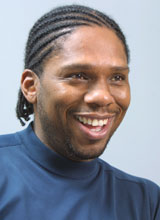 |
Trends in Japan is featuring interviews
with notable foreign residents of Japan. Stepping up to the plate this time is one
of the most well-known and popular athletes in Japan, Carl "Tuffy"
Rhodes.
CARL "TUFFY" RHODES:
The American Samurai
August 6, 2002
"I can play baseball already; that was the easy
part. Coming to a different country, learning a different culture was
the hard part. So I came over here with the attitude that I was going
to learn everything about Japan, not just about baseball, but everything
about Japan - the culture and the language."
Carl Derrick Rhodes - better known by his nickname Tuffy - is perhaps
Japan's best-loved foreign baseball player. Now in his seventh season
with the Osaka-based Kintetsu Buffaloes of the Pacific League, he has
won the hearts of his Japanese teammates and fans alike through his professional
achievements as well as his mastery of things Japanese, including the
language.
"My teammates call me hen na gaijin,"
Rhodes laughs. "Last year, I was hen na gaijin;
now I'm hen na Nihonjin. So I went from 'weird
foreigner' to 'weird Japanese'!" The Japanese, traditionally shy
of accepting a foreigner as one of their own, have taken to describing
foreigners who demonstrate exceptional understanding of their ways as
hen na gaijin. While literally translated
as 'weird foreigner,' it is actually a way of expressing affection, and
often admiration, for the individual. It is a further compliment that
his teammates now call Rhodes hen na nihonjin,
an accomplishment that matches his achievements on the field. Last year
Rhodes led the Buffaloes to their first Pacific League pennant in 12 years
by hitting 55 home runs - tying the record held by Japan's legendary
home run king Sadaharu Oh.
|
 |
While other foreign players have also left their mark
in Japan's professional baseball, they were often considered "temporary
helpers" judged only on their performance. It was rare for a gaijin
player to develop a complete rapport with his Japanese teammates and fans.
Not so Rhodes. "The great thing about it is that my teammates see
that I'm not just over here being a regular gaijin - ones who come over
here just for the money. I got great friends - my teammates are my friends
- and I consider them my family," he says.
And Rhodes certainly did his part, starting with learning the Japanese
language, which surprised his teammates. "I tried to speak Japanese
to them from day one, and communicate to their eyes in the way they communicate,
instead of their trying to communicate to me, because it's not fair."
Getting used to other aspects of Japanese life, like taking one's shoes
off upon entering a house and using chopsticks, were comparatively easy
for Rhodes, whose next challenge is trying on a kimono with geta
(wooden sandals) - a custom that has become very rare among ordinary Japanese
men - and buying a sword. Aware of his fondness for the ways of the samurai,
his teammates have been teaching him phrases like katajikenai,
a samurai expression of gratitude.
|
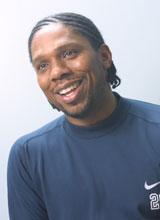 |
Rhodes speaks the dialect of Osaka, which he has
come to consider his home. "If I were a Japanese, I'd probably be
an Osakan. Osaka people are more aggressive, and a lot funnier too, and
outspoken. And that's how I am. I fit in perfectly with them."
Meanwhile, there is something even a committed Japanophile like Rhodes
hasn't been able to get used to - the strenuous two-month spring training
that is a regular feature of professional baseball in Japan. "Americans,
we like to keep everything simple. You know, the easy way. If we can work
from nine to twelve, that's great. But the Japanese people, everything
is work, work, work, work!" he exclaims. "But I do it, you know.
I do it, and every time I do it, I'm proud of myself. It's tough, but
it's rewarding at the same time because I play a game that I love, and
my coaches and our conditioning coaches keep us in the best shape to be
out there on the playing field."
But it was out there on the diamond last year that Rhodes experienced
a major disappointment in Japanese baseball. On September 30, the ball
park was packed with 33,000 fans, not only to cheer the Buffaloes - who
had already clinched the league championship by that time - but to witness
Rhodes hit his much-anticipated 56th homerun and break a record that had
stood for 37 years. By some trick of fortune, the opponent that night
was the Daiei Hawks, the team led by record-holder Sadaharu Oh. The Hawks
chose to walk Rhodes, a tactic that so disappointed Rhodes that it sapped his determination.
"That's a record, and records are meant to be broken," he says,
adding that he was encouraged by many Japanese who expressed their support
for him.
Rhodes, who is 34, had always told himself he would
stop playing at 35. While his performance so far might make him reconsider
this plan, he has decided on one thing - that he will end his professional
career in Japan, in Osaka, with the Kintetsu Buffaloes. "I'm finishing
my career here. I'm playing baseball as long as I'm in Japan. I don't
have any plans to go back to America to play baseball. I don't even talk
to American teams who call my agent in the off season, because I'm not
interested. I'm only interested in playing with the Buffaloes."
And when the time comes to leave Japan, what will he miss most? "Being
away from my teammates, my friends, will be very tough. Not waking up
in the morning with spring training. . . . It's tough now, but when it's
over you really miss stuff like that." Then again, "You never
know," he adds grinning, "I might find me a Japanese wife!"
 Carl "Tuffy" Rhodes
Born in Ohio in 1968. Earned nickname "Tuffy"
when he was six for not crying after being hit in the eye with a baseball.
Played professional baseball for the Houston Astros, Chicago Cubs, and
the Boston Red Sox before coming to Japan to play for the Kintetsu Buffaloes
in 1996. Led the Pacific League in home runs in 1999. Hit a record-tying
55 home runs in 2001 while helping lead the Buffaloes to their first pennant
in 12 years.
|
Copyright (c) 2002 Japan
Information Network. Edited by Japan Echo Inc. based on domestic Japanese
news sources. Articles presented here are offered for reference purposes
and do not necessarily represent the policy or views of the Japanese
Government. |
|
|


