
|
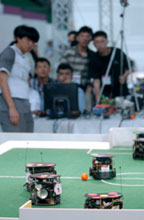 Robots competing in a soccer match. (Jiji) |
ROBOCUP:
Soccer-Playing Robots Gather in Fukuoka and Busan
July 30, 2002
Homemade robots got the chance to try out their techniques
in a competition known as RoboCup 2002 Fukuoka/Busan, which was held at
the Fukuoka Dome on June 19-25. The highlight of this event was the soccer
tournament pitting robots from around the world against each other. This
year "humanoid" robots took part in the event for the first
time, and the long-term goal of this effort is "to develop a team
of fully autonomous humanoid robots that can win against the human world-champion
soccer team by 2050." While realizing this goal is still far away,
the first steps have already been taken.
Event Coincides with World Cup
The aim of the RoboCup is to merge robotics with artificial intelligence
and develop the resulting combination. The idea for the tournament was put
forth by Japanese researchers, and the first RoboCup was held in Nagoya
in 1997. Subsequent events were held in Paris, Stockholm, Melbourne, and
Seattle, and this year's event in Fukuoka is the sixth. Like the World
Cup, RoboCup was co-hosted by Japan and South Korea, and a record
number of participants turned out - about 1,000 people in 193 teams
from 30 countries. The event was open to the public for the five-day period
ending June 23, and about 120,000 showed up to catch a glimpse of the
robots.
The main event of RoboCup was the soccer competition. Previously, most
of the robots have been bucket-shaped machines that run on wheels, but
bipedal "humanoid" robots made their debut this year, and there
were a total of five separate leagues. The most intense competition, though,
is in the middle-size robot league, and technical progress is being made
there every year. This year corporate teams took part. Aside from turning
the robots on at the beginning of the match and off afterwards, there is no
human control of the robots during the match. The robots communicate with
their "teammates" by virtue of a wireless network, and they
try to kick an orange ball into a yellow or blue goal.
Robots in the humanoid league range from 40 to 180 centimeters in height,
and there were 12 teams in this league. But even though this is the "humanoid"
league, technology has just recently been developed to the point of allowing
bipedal robots to walk, so a soccer match among them is out of the question
at present. Instead, the humanoid robots are timed on how long it takes
them to walk a distance equivalent to five times their height, and they
are also graded on how many goals they can score out of five penalty kicks,
among other things. The Gifu Industries' Association's NAGARA was the
winning team, as its robots converted the most penalty kicks and demonstrated
the ability to walk smoothly.
Aiming to Best Human Players
The researchers from all the different countries that are participating
in RoboCup intend to create a team of robots that will be able to defeat
the World Cup champion team by the year 2050. The technology is improving
by leaps and bounds every year, and the robots are now able to pass and
shoot accurately. The open nature of the competition has played a role
in the rapid technological progress; after the matches, all of the technology
and techniques are made public so that the participants can learn from
each other.
It is hoped that the research and development involved will lead to the
appearance of new technologies that can be used by industry and ordinary
companies. For example, experts have noted that technology making
it possible to avoid obstacles and to move faster will be useful in expanding
the range of activities that industrial robots can handle, and they have
also pointed out that the use of wireless technology in places where there is a great deal of background noise, such as factories, offers much potential.
In addition to the soccer competitions, there were also contests, both
real and simulated, involving rescue robots. In the Rescue Robot league,
robots searched through the rubble of a collapsed building, attempting
to locate a human-sized doll. In the Rescue Simulation league, a similar
disaster was constructed on a computer screen, and the programs entered
in the competition gave directions to simulated police and rescue personnel
in order to locate the victims.
One application of this new technology that has caught the attention of
many local governments is a computer program that simulates a major disaster
in a metropolitan area. Different techniques of preventing the spread
of damage and rescuing as many people as possible can be tested against
one another in order to find the most effective methods of dealing with
such a crisis.
|
Copyright (c) 2002 Japan
Information Network. Edited by Japan Echo Inc. based on domestic Japanese
news sources. Articles presented here are offered for reference purposes
and do not necessarily represent the policy or views of the Japanese
Government. |
|
|


