
|
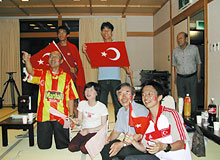 Fans cheer on the Turkish team in the World Cup. (Jiji) |
A LEGACY OF GOODWILL:
World Cup Inspired International Exchange
July 9, 2002
The 2002 FIFA World Cup Korea/Japan began on May
31 and lasted one month, thrilling people all over the world. The Japanese
team's better-than-expected performance delighted people throughout the
country. During Japan's games the vast majority of the public was focused
on the match, whether in the stadium, in their living rooms, or about
town; the whole nation went soccer crazy. Meanwhile, residents of places
that hosted training camps and World Cup matches all over Japan warmly
welcomed foreign players and fans, and the World Cup became a forum for
a variety of international exchange. Children were especially excited
at getting the chance to see some of the world's top soccer stars. Japanese
fans were unstinting in their support of the foreign teams playing in
Japan and made many friends with traveling supporters. This genuine warmth
was loudly applauded by the foreign media.
Exchange Begins Before Kickoff
The first thing foreign teams experienced after landing in Japan was the
welcome afforded them at training-camp and match venues. One such venue,
the village of Nakatsue, Oita Prefecture, on the island of Kyushu, became
probably the most famous village in Japan thanks to its hosting of the
Cameroon team. Things did not start well, however. The team was severely
delayed during its journey to Japan and arrived five days later than planned,
at 3:00 a.m. on May 24. Despite the late hour, many of the villagers gathered
outside the team's quarters to greet the players. These events received
widespread coverage in newspapers and on TV, making Nakatsue famous throughout
Japan.
The children of Nakatsue Elementary School described on the Internet the
many exchange activities that took place between the villagers and the
Cameroon players. For example:
"Since the Cameroon team decided to set up camp in Nakatsue, we have
found out a lot of things about Cameroon."
"Together with members of the village's seniors club, we made Cameroonian
flags for waving to support the Cameroon team."
"The toddlers at Nakatsue Daycare Center are learning French so that
they can support Cameroon. Meanwhile, middle-school students have been
learning the Cameroonian national anthem. The members of the music club
hope to impress the team with their performance."
"The Cameroon team played a practice match against a team of high-school
students from Oita Prefecture. About 1,300 people came to watch the game.
Only 1,370 people live in our village, so I was surprised that so many
people came. Two of the Cameroon players joined the high schoolers to
help them out during the game. The young players on the school team chased
the ball earnestly and put all of their effort into every shot. In the
end, Cameroon won 2-1. Seeing how the high schoolers battled so hard against
much stronger opponents made me realize how important it is to try one's
best."
Japanese Fans Support Other
Teams Too
The Japanese team performed better than expected at the World Cup, drawing
with Belgium and defeating Russia and Tunisia to advance to the knockout
stage of the tournament. As well as the nearly 50,000 spectators that
filled the stadiums for each match, people all over the country joined
together to cheer on their heroes. The TV viewing figures for the Japan
vs. Russia match were particularly impressive, recording the second highest
ratings ever for a sports event. An average of 66.1% of viewers watched
the game in the Kanto region. Although the team lost to Turkey in the
round of 16, the Japanese public heartily applauded the players for showing
the world what the "new Japan" is capable of.
Japanese fans were equally happy to lend their voices of support to foreign
teams. In particular, their message to fellow hosts South Korea was "Let's
go to the knockout stage together," and as the Korean team progressed
to the quarterfinals and then the semifinals, Japanese fans urged them
on "to the final in place of Japan."
Many foreign players garnered popularity among Japanese people. Perhaps
the most noticeable was England midfielder David Beckham. Whenever Beckham
got the ball during a match, spontaneous applause broke out, and when
he took corner kicks the flashes from countless cameras lit up the stadium.
Groups of Beckham fans followed the England team around, and there was
a boom in mohicans as young people rushed to hair salons to request a
haircut to match Beckham's.
The foreign media was glowing in its praise of Japan' handling of the
World Cup. One surprised reporter for the British daily The
Mirror wrote: "At the England game, over 30,000 Japanese fans
sang the British national anthem. Some of them had painted their faces
with the England flag. No, I have not gone crazy. This is the truth."
The Financial Times commented: "Through
their passion for other teams as well as their own, the Japanese have
made the World Cup richer." A player on the Belgian team said, "Even
though we are in the same group as Japan, everywhere we go there are Japanese
fans cheering us on. It's unbelievable." Meanwhile, some Irish journalists
said, "When we'd finished work for the day and went back to our hotel
at 2:00 a.m., the staff greeted us with a round of applause outside the
entrance. We were very touched."
The World Cup was a great opportunity to let people from around the world
experience Japanese hospitality firsthand.
|
Copyright (c) 2002 Japan
Information Network. Edited by Japan Echo Inc. based on domestic Japanese
news sources. Articles presented here are offered for reference purposes
and do not necessarily represent the policy or views of the Japanese
Government. |
|
|


