
|
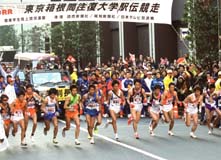 The runners start the Hakone Ekiden race in the Otemachi district of Tokyo. (Jiji) |
LONG-DISTANCE LOVE AFFAIR:
Ekiden Has a Special Place in Japanese Hearts
January 29, 2002
Marathons and other long-distance running events are immensely popular in Japan, and one such race has become an essential New Year custom. The Tokyo-Hakone Ofuku Daigaku Ekiden, a relay race between teams of male university students from Tokyo to the mountainous Hakone area and back, is one of the most popular such events in the sporting calendar. The oldest ekiden, it began in 1920 and was held for the seventy-eighth time on January 2 and 3, 2002. The race attracted enormous interest all over Japan, with viewing figures of 27% for live TV coverage and thousands of people lining the course to cheer on the runners. The term ekiden is even becoming known internationally.
Passing the Cloth Sash
Ekiden originated in Japan. The word comes from the names of two ancient systems of relay transportation using horses - eki means station, and den means transmit. In ekiden races a tasuki (cloth sash) is passed from one runner in a team to the next at the end of each leg (in the Hakone Ekiden there are five outward and five return legs). Each tasuki is thought to represent the honor not only of the team itself but of the university, company, or region that the team comes from, and changes to the order in which the sashes pass by bring joy and sorrow to the watching fans.
At first glance the tasuki appears to play the same role as the baton in track-and-field relay races, but in fact the sashes have a number of deeper meanings. Some observers even say it is the tasuki's symbolic significance that makes ekiden special. In the five outward and five return legs of the Hakone Ekiden, even if a team has one or two outstanding runners, if the overall level of the team is low it will make little impact. On the other hand, teams without a single exceptional runner but whose members are all of a reasonable standard have a realistic prospect of finishing well up the field.
|
|
As usual, this year's Hakone Ekiden was packed with drama. One of the best long-distance runners in Japanese college sports ran the second outward section for his university but pulled a muscle in his leg soon after receiving the cloth sash from the previous runner. He suddenly slowed down. Desperate to get the tasuki to the next runner, however, for a time he tried to run off the injury, escaping the clutches of the team coach, who was trying to get him to retire. In the end he had to withdraw. This scene was broadcast in close-up on TV, bringing many viewers to tears. Every year the nerves, excitement, joy, and despair of these young athletes elicit waves of emotion among the Japanese public, and this emotional involvement is one of the reasons the Hakone Ekiden is so popular.
The Story Behind the Hakone Ekiden
The Tokyo-Hakone Ofuku Daigaku Ekiden is contested by 15 universities from the Kanto region. The route runs from Otemachi, a Tokyo business district, to Lake Ashi in Hakone, a popular tourist region in Kanagawa Prefecture, and back, a total distance of 216.4 kilometers (136 miles). The 10 runners of each team tackle the course over two days in 10 relay stages. Each team member runs about 20 kilometers, and in all the race takes about 11 hours. The main organizer is the Kanto Students Athletics Association, a student organization. The event is run by students, who handle entries, make pamphlets, manage traffic, and control the crowds of fans that line the course.
Many athletes have fallen for the attraction of the Hakone Ekiden, which has a long history. Yoshio Koide, the highly respected coach of Sydney Olympic women's marathon gold medalist Naoko Takahashi, is one example. After graduating from high school, Koide took over his family's farm. But after a while he entered Juntendo University in the hope of competing in the Hakone Ekiden, a dream that came true soon afterwards.
|
Copyright (c) 2002 Japan Information Network. Edited by Japan Echo Inc. based on domestic Japanese news sources. Articles presented here are offered for reference purposes and do not necessarily represent the policy or views of the Japanese Government. |


