
|
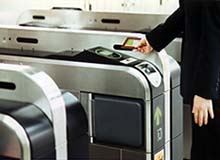 Using a Suica pass at a ticket gate. (JR East) |
TOWARD A TICKETLESS STATION:
New Hi-Tech Train Pass Makes Commuting Easier
January 8, 2002
Workers and students in Japan rely on train passes to commute to the office or school. Commuters can buy a train pass valid for one, three, or six months, and the period of time and the stations used are recorded on the pass magnetically. When entering and exiting a station on that route, the user inserts the pass into an automatic ticket gate. Up to now, a train pass could only be used at the stations along the specified route, but a new kind of pass that includes an IC chip can be used at other stations as well, functioning as a kind of electronic money. It is believed that this new technology may lead to ticketless, cashless stations in the future. The first of this new type of rail pass, called Suica (Super Urban Intelligent Card), was introduced in the Tokyo area by East Japan Railway Co. (JR East) on November 18, 2001. Suica is pronounced the same as the Japanese word suika, which means "watermelon."
Touch and Go
|
 A Suica commuter pass (top) and two Suica IO passes. (JR East) |
Previously, when a rider entered a station with a train pass and exited at a station outside the valid area, he or she had to insert the pass into a fare-adjustment machine that would calculate the extra charge. When entering a station outside the area covered by the train pass, a ticket was required. Suica has made all of this unnecessary.
Suica Benefits Railway Companies as Well
While commuters may find the new train pass convenient, Suica offers a number of benefits to railway companies as well. Up to now, magnetic train passes and tickets have been inserted into automatic ticket gates and have been mechanically propelled through the gates, popping out at the other end. The parts that come into contact with tickets and passes experience a great deal of wear, and maintenance costs are high. The introduction of Suica is making stations more efficient by shrinking maintenance costs and allowing JR East to reduce the number of fare-adjustment machines.
|
|
In addition to the combination of a commuter pass and a prepaid card, a prepaid-only IC card, called a Suica IO card, can be purchased. Because IC cards can store more information than magnetic ones, prepaid cards have become more secure. The added security makes it feasible for the cards to hold a much greater amount of credit.
Train tickets are becoming a type of electronic money, and while Suica is limited to the Tokyo area, it may become possible in the future to buy long-distance tickets using IC cards. It is conceivable that the station of the future will be a ticketless, cashless one. There is also a possibility that these cards could be used in lieu of money someday at the large department stores run by private rail companies.
At present, Suica can only be used at JR East stations and is not compatible with either the subway system or the large number of private railways in the capital, which have their own prepaid cards. Under these circumstances, only about 4 million users are expected. But interest in the system is widespread, and the number of users is expected to explode if JR West and private rail companies make their systems compatible.
|
Copyright (c) 2002 Japan Information Network. Edited by Japan Echo Inc. based on domestic Japanese news sources. Articles presented here are offered for reference purposes and do not necessarily represent the policy or views of the Japanese Government. |


