
|
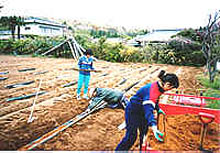 A 19-year-old volunbeiter helps to grow yams on a farm in Ibaraki. (Sanka Network) |
DOING GOOD WORK:
New Breed of "Volunteer" Worker On the Rise
November 5, 2001
More and more young Japanese are turning to part-time jobs with a "volunteer" flavor. Rather than a simple paycheck, these workers are looking for new, more meaningful experiences, or the chance to contribute to society. With its emphasis on these non-monetary benefits, this is not ordinary part-time work; but it is paid, so the term "volunteer" is not applicable, either. A new word has been coined to describe this kind of labor: volunbeit, a combination of "volunteer" and "Arbeit," the German word for "work" that has been imported into Japanese to describe part-time or irregular labor. The volunbeit boom is beginning to spread, as more workplaces take notice of this new breed of worker and older generations also get into the act.
More Than Just Money
One happy "volunbeiter" is a college graduate in his mid-twenties who provides nursing care for a homebound quadriplegic in Setagaya, Tokyo. The care recipient enjoys the services of a home-care specialist and other volunteers, but even with this help there are some times of day left unfilled. To ensure 24-hour care, he hired this volunbeiter, who explains: "Japan's society is aging rapidly, and everyone stands the chance of needing care at some point. I had been interested in the idea of offering nursing care before, so this was the perfect opportunity."
Two other volunbeiters are working on the weekends, helping with chores on a farm in Saitama Prefecture run by a couple in their seventies. A male college student and female office worker from Tokyo, they answered the call when the couple's son, a company employee, advertised for people to help his elderly parents. The two are pleased with their positions: "These certainly aren't high-paying jobs, but they do offer experiences we could never get elsewhere."
All these volunbeiters found their jobs through Internet listings maintained by Sanka Network, a Tokyo networking firm. The company has for the past two years hosted job listings and ads from job seekers on its site. Pay levels for the jobs must clear the legal minimum wage defined in the areas where the work is to take place, and on average the pay offered is less than what a part-time worker could expect in a regular position. But according to a company spokesperson, "there are more and more young people looking for work in nursing care, agriculture, and the nonprofit sector. And a growing number of companies are looking for this kind of worker." The firm now has about 3,000 prospective volunbeiters on its books.
Established outlets of job information are responding to this heightened interest among younger workers. In March 2000 a major job-listings magazine began carrying a regular feature on volunteer work. Another similar publication has set up a section on work "for society and for people," which has proved popular with its readers.
And the interest is not limited to the younger generation. One NPO based in Tokyo, Lifestyle, Welfare, and Environment 21, has crafted a plan to get older people into the act. Its "mature volunbeiter" scheme has already attracted more than 10 older people who are ready to contribute to society. As an organization representative notes, "by supporting the efforts of these mature individuals, who have retired and are free to pursue new activities, we can tap into a powerful societal resource."
Bad Economy Good for Volunteerism?
|
|
The general perception of this trend is that it began to take root during the 1990s, a decade during which educational reforms placed more emphasis on Japanese students developing their individuality. It was also a decade of spotty performance for the Japanese economy, and getting a job with a company no longer meant a guarantee of a stable future. With this in mind, some say, many young people decided to pursue something they truly believed in, and the volunbeit boom was born.
The system of lifetime employment that was once the pride of Japan's companies is showing cracks. In this increasingly uncertain job environment, it cannot be said for sure that volunbeiters will grow in number to rival the "freeters," the vast pool of mobile youth who jump from job to job. But the trend has definitely taken hold as one to watch on Japan's labor scene today.
|
Copyright (c) 2001 Japan Information Network. Edited by Japan Echo Inc. based on domestic Japanese news sources. Articles presented here are offered for reference purposes and do not necessarily represent the policy or views of the Japanese Government. |


